Bond / Gilt Investment Opportunity for Short Term
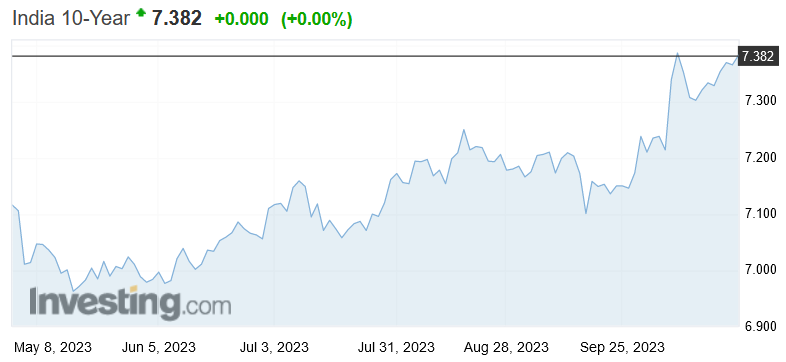
10-Year “Government of India ( GOI ) Bond” Interest Rate ( Yield ) Chart
10-Year “USA Treasury Bond” Interest Rate ( Yield ) Chart

Bond Yield and Bond Price Correlation
The simple fact is price of bond is inversely ( negatively ) related to interest Rate ( Yield ) on the bond. In layman terms this means –
- When yield goes up, price of bond falls, thereby investment in the bond gives negative return
- When yield goes down, price of bond rises, thereby investment in the bond gives positive return
The possible scenario and probability forward for Yield –
- Yield Move Much Higher – Less Likely
- Yield Stay at current level for some time – Likely
- Yield Move Lower – Most likely
Rationale for Yield Moving Lower
- High Yield NOT Good for Economy – All business uses borrowings to expand and grow. Individuals take loans to purchase assets and consumption like home loan, car loan, etc. Interest rate on borrowings and loans are always related to Yield on GOI 10-Year Bond. High Yield increases the borrowing cost for businesses and individuals. So high yield is bad for economic growth, development and consumption. The Governments and Central Banks, like RBI & “Federal Reserve of USA” do take actions to reduce the bond yields. For example “India cautious of ‘unexpected’ spike in govt bond yields – official“. So historically, yields do not stay at higher levels for long period of time. Yields are most probably headed down in the near future
- Inflation and Yield Correlation – Yield on GOI 10-Year Bond is directly correlated to prevailing inflation. As the inflation in USA is high, so the Yield on USA’s 10-Year Treasury Bond is also high. Keeping pace with Yield on USA Treasury, Yield on GOI 10-Year Bond is also high. For example “Indian benchmark yield above 7.35% as US peers move upwards“. As inflation will trend downward, the Yield should also trend downwards
High level of Bond Yield is an Investment Opportunity – Gilt Mutual Fund
As shared earlier, falling yield is good for investment into bonds. Very crudely, around 0.25% fall in yield can generate around 2% return in bond investment ( this is not a gospel truth! ). Gilt Mutual Funds are products investing into 10-year bonds and longer duration bonds. In the current high interest rate scenario, Gilt Mutual Fund can be a Tactical or Opportunistic Investment.
Investment Strategy
- Invest over a period of time like few days OR few weeks OR few months
- Some of the Gilt Mutual Funds available for investment are –
- ICICI Gilt Fund
- SBI Magnum Gilt Fund
- Kotak Gilt Fund
Exit Strategy
Do remember Gilt Mutual Funds are short term investments, they are NOT long term investments. As yield do not keep falling for long period of time. After sometime, the yield will start rising, thereby hurting the bond investments. So it is advisable to have an exit strategy, that is when to exit the investment in Gilt Mutual Fund. Exit strategy can be based on –
- Yield – Exit when yield falls to a certain level
- OR
- Return – Exit when the investment has generated certain return
HAPPY INVESTING
DISCLOSURE – I am have invested in ICICI Gilt Fund and SBI Magnum Gilt Fund
DISCLAIMER –
Equity/Stock/Share/Mutual Fund investment are subject to market risks. The article/post is NOT an investment advice. The article/post is an opinion. Please do your own research and/OR consult your investment advisor before making your investment. Past performance is not indicative of future returns. Please consider your specific investment requirements before choosing your investments or designing a portfolio that suits your investment needs. The article/post or the author cannot be held responsible for any losses